


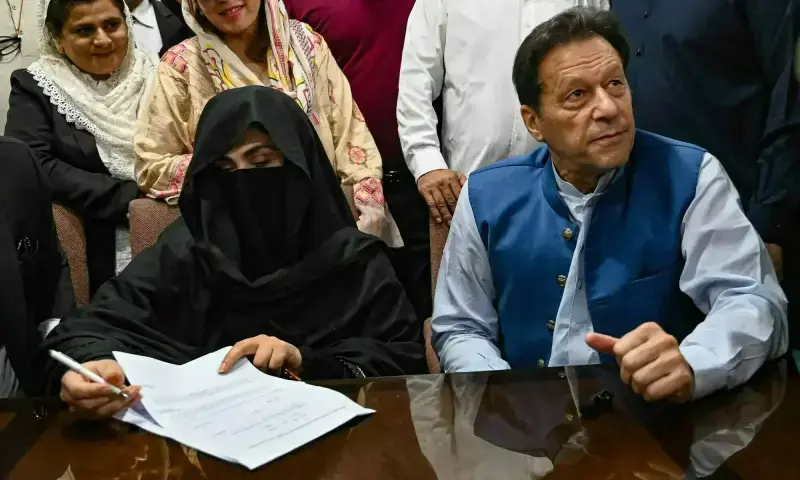
PTI founder and former prime minister Imran Khan and his wife, Bushra Bibi, on Monday filed separate appeals with the Islamabad High Court (IHC) challenging their conviction in the Toshakhana 2 case.
A special court on December 20 sentenced Imran and Bushra to 17 years imprisonment in the case, which pertained to the purchase of an expensive Bulgari jewellery set, gifted to Imran by the Saudi crown prince during an official visit in May 2021, at a throwaway price.
During the proceedings, the prosecution contended that the PTI founder retained the jewellery set, valued at approximately Rs80 million, after paying only Rs2.9m.
According to copies of the appeal available with Dawn, the couple’s lawyers contended that the sentencing was politically motivated, arguing, “The overarching objective of the present prosecution appears to be the continued incarceration of the appellant, thereby preventing his participation in national politics and curtailing his political role and influence.”
Furthermore, it was noted that the case, initiated by the National Accountability Bureau (NAB), had been transferred to the Federal Investigation Agency (FIA).
“The learned trial court overlooked the methodology adopted by the Federal Investigation Agency in conducting the investigation. In the absence of settled law, precedent, or clear guidance on the subject, heightened care and caution were required in interpreting and applying the governing legal framework,” the appeal read.
“Instead, both the investigating agency and the Trial Court proceeded in a cursory manner. This is evident from the absence of any FIR (first information report) on the record.”
The appeals also noted that the FIA submitted a challan “within two days of the initiation of the investigation”, leaving inadequate time to conduct a fair and transparent probe.
It was further noted that the Toshakhana 2 conviction was the fourth prosecution in the Toshakhana cases and constituted double jeopardy, “reflecting a repetitive and overlapping invocation of criminal process in respect of the same subject matter”.
“NAB deliberately chose to bifurcate the prosecution by selectively proceeding in respect of one set of gifts while deferring or abandoning prosecution in respect of the others. Such a course of action is impermissible in law,” the appeals read, noting that Toshakahana 1 and 2 revolved around different gifts.
“The bifurcation of what ought to have been a single, composite trial into multiple proceedings was undertaken with the ulterior motive of ensuring the continued incarceration of the present appellant,” the appeals argued.
Moreover, the appeals stated that the conviction ignored the 2018 Toshakhana policy, with Clause I, mandating that all gifts received shall be duly reported and deposited with the Toshakhana.
Clause VI “provides that gifts valued above Rs30,000 may be retained by the recipient upon payment of 50 per cent of the value exceeding the basic exemption of Rs30,000”.
The appeals further argued that there was no violation of the Toshakhana policy, as the gifts were deposited and fees to retain the gifts were paid. It further noted that there are no criminal provisions or charges of criminal breach of trust or criminal misconduct envisaged in the policy, making the sentencing unlawful.
“The learned trial judge misread and misapplied the relevant Toshakhana Policy/Rules governing retention of gifts,” the appeals read.
“The prosecution wholly failed to establish the guilt of the appellant and his wife beyond [a] reasonable doubt; however, this fundamental deficiency was entirely overlooked by the learned Special Judge, Central, while recording the conviction.”
Furthermore, the appeals contended that a criminal breach of trust requires the entrustment of property, dishonest misappropriation of such property for the accused’s own use, and in cases falling under Section 409 (criminal breach of trust by public servant, or by bank, merchant, or agent) of the Pakistan Penal Code (PPC), the accused must be a “public servant”; they contended that Imran and Bushra did not meet these requirements.
“In the present case, the prosecution has failed to establish any of these foundational elements. There was no dishonest misappropriation or conversion, as the gifts were duly retained strictly in accordance with the Toshakhana Policy and Rules after payment of the requisite assessed amount,” the appeals read, arguing that Imran did not fall within the definition of a public servant as per Section 21 of the PPC.
“The learned trial court, in paragraph 15 of the impugned judgment, has manifestly faltered in bringing the appellant within the ambit of the definition of a ‘public servant’ by relying upon the ninth description of Section 21 PPC, coupled with vague precedents from 1957 and 1961. This reflects a flawed, incorrect, and legally unsustainable approach,” Imran’s appeal read.
Bushra’s appeal noted that she was “a housewife who has never held, occupied, or performed the functions of any public office”, meaning that the ruling was “coram non judice, without lawful authority, and liable to be set aside in its entirety”.
The appeals requested that the December 20 judgment be set aside and that Imran and Bushra be acquitted of the charges in the Toshakhana 2 case.
Imran and Bushra Bibi were indicted in the case last year in December. Earlier this year, in October, the two had denied all allegations in the case, terming it a fabricated and politically motivated attempt to disqualify Imran from politics.
Imran, imprisoned since August 2023, is serving a 14-year sentence at the Adiala jail in a £190 million corruption case and also faces pending trials under the Anti-Terrorism Act related to the protests of May 9, 2023. Bushra Bibi is also serving a seven-year sentence in £190 million corruption case.
Dawn – Homenone@none.com (Tahir Naseer)Read More