

PARIS: Journalism around the world is in dire straits, with Reporters Without Borders’ (RSF) Press Freedom Index calling it the worst year since records began.
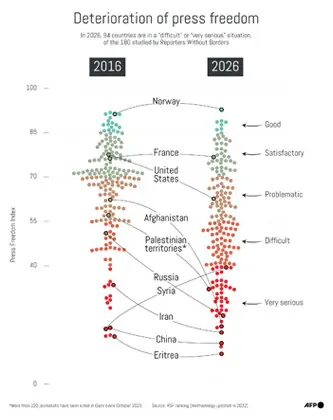
For the first time in its 25-year history, over half of the world’s countries now fall into the “difficult” or “very serious” categories for press freedom, the media watchdog noted.
“Since RSF began publishing the World Press Freedom Index 25 years ago, press freedom has been gradually deteriorating,” it noted in the sobering report, released ahead of World Press Freedom day, which will be observed tomorrow (Sunday).
“Journalists are still being killed and imprisoned for their work, but the tactics undermining press freedom are evolving. Journalism is being asphyxiated by hostile political discourse towards reporters, weakened by a faltering media economy, and squeezed by laws being used as weapons against the press.”
RSF Press Freedom Index paints dismal picture; more than half of the world deemed ‘difficult’ for journalists or worse
According to RSF statistics since Jan 1, 2026, 13 journalists were killed around the world, while 471 are currently detained. In addition, at least 21 journalists are held hostage, while 135 remain missing in action.
The US, which had already fallen from a “fairly good” to a “problematic” situation in 2024, the year of Donald Trump’s re-election, has dropped a further seven places to 64, it said.
US President Donald Trump has turned his repeated attacks on the press and journalists into a systematic policy, pushing the US down to 64th place (-7).
The drastic cuts to the US Agency for Global Media (USAGM) workforce had global repercussions, leading to the closure, suspension and downsizing of international broadcasters such as Voice of America (VOA), Radio Free Europe/Radio Liberty (RFE/RL) and Radio Free Asia (RFA) in countries where they were some of the last reliable sources of information.
Among some of the most disturbing of RSF’s findings was that the criminalisation of journalism has reaches a peak.
The Index’s legal indicator has seen the most severe decline this year. This score deteriorated in more than 60pc of states — 110 out of 180 — between 2025 and 2026.
This is notably the case in India (157th), Egypt (169th), Israel (116th) and Georgia (135th). The criminalisation of journalism, which is rooted in circumventing press law and misusing emergency legislation and common law, is proving to be a global phenomenon.
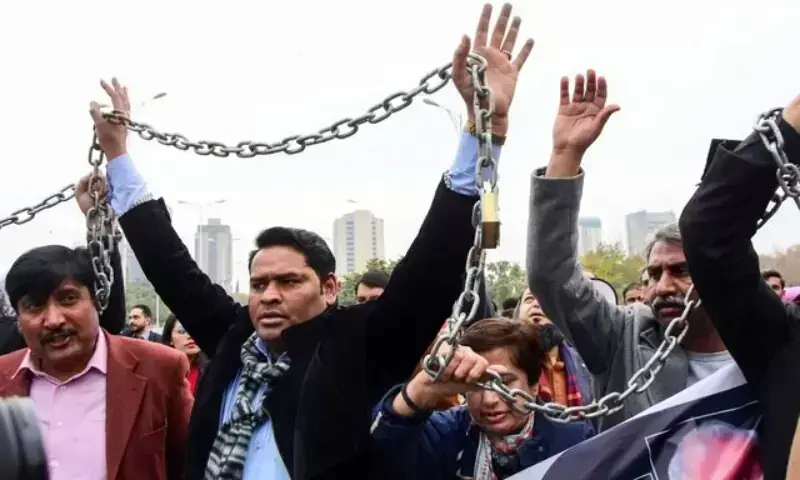
In Pakistan (153rd), the press faces relentless waves of restrictions amid a fraught political climate in which authorities seek to control, and in some cases suppress, the dissemination of journalistic content, RSF said.
Among the countries closed off to the independent press, Vladimir Putin’s Russia (172nd) has become a specialist in using laws designed to combat terrorism, separatism and extremism to restrict press freedom.
Even in established democracies, legal provisions can undermine press freedom. In Japan (62nd), the state secrecy law continues to have a chilling effect on journalism as there are no adequate protections for source confidentiality to counterbalance it, which breeds self-censorship.
In South Korea (47th), government measures introduced to combat the spread of “false information” have drawn criticism from press freedom organisations, yet another example of the persistent tension between tackling disinformation and preserving the right to report.
Published in Dawn, May 2nd, 2026
Dawn – Homenone@none.com (Agencies)Read More