


Population has long been viewed as a simple denominator — a way to calculate per capita resources and economic standing. But behind the numbers lies a more urgent reality: Pakistan’s 251 million people, with an income of $1,484 per capita and a growth rate of 2.5 per cent, are on track to swell to 386m by 2050.
This rapid surge will demand far more than headline figures can capture: more safe drinking water per capita, more doctors and hospital beds per capita, more schools and teachers per capita, more police per capita, and more electricity, gas, and essential services across the board.
Development policy and governance frameworks treat population as a core management indicator for assessing various deprivations and projecting future needs for economic growth and social development. In doing so, the literature on population studies and policies draws extensively from other fields of knowledge, including cultural studies, economics, public health, and institutional coordination theories.
One of the core arguments in this literature is that effective population policies, and the governance structures needed to support better population management, emerge from at least three conditions. First, they require a broad-based consensus within state governance and policy-making systems that population growth is a central policy priority.
Second, they depend on serious investment in healthcare infrastructure to ensure the delivery of family planning services and counselling.
Third, they necessitate long-term, sustained improvements in inclusive growth, particularly in education, mobility, and employment opportunities for women.
On this scale of population governance, Pakistan offers an interesting story of the rise and fall of management policies. It was one of the first countries, back in 1958, where civil society, and then the government in 1965, started talking about population management policy and the need to make population a centre point in economic planning.
The years from 1965 to 1975 are called the first push years. However, the years 1972–1981 witnessed a population growth spurt, while there was a progressive decline in public policies around population management until the late 1980s.
Population policy specialists call the 1977 to 1988 era “the lost decade.” The fertility rate started to decline ten years later than the rest of South Asia (in the 1990s), while remaining at a higher level (4.1pc) with contraceptive prevalence rate levelling off around 30pc.
However, during 1989–98, Pakistan’s population welfare policy community witnessed a resurgence in emphasis on population under various initiatives such as the Social Action Programme, the Lady Health Workers Programme, the Planning Commission’s Vision 2030, among many others.
After the 18th Amendment in 2010, population welfare has been devolved to the provincial governments along with health, education, and women’s issues.
During a recent meeting at the Planning Commission, provincial and federal governments were found discussing “fragmentation” in population planning mechanisms, while Prime Minister Shehbaz Sharif has emphasised the need for a unified national policy for population stabilisation and welfare.
Interestingly, during this period — and continuing today — South Asian states such as Bangladesh and India, as well as countries like Iran, achieved far stronger outcomes in slowing population growth. Their performance on building consensus around population measures, strengthening reproductive healthcare, and advancing women’s socio-economic status has consistently outpaced Pakistan’s.
However, Pakistan’s development paradigms could not find any substantial use of the population argument in five-year plans despite international donors and local non-governmental organisations laying emphasis on the need to do so.
At the institutional levels, the Ministry of Population Welfare and the Ministry of Health could not find a common ground, diverging from the turf war they keep fighting on various issues — healthy ageing being one of the latest.
Even the donors were not persistent in providing financial leverage to population services, and emphasis shifted to HIV/AIDS and polio eradication and other development priorities, leading to short-termism in addressing the larger population management question.
The fragmentation and inconsistency in policies and planning have led to patchy and/or near-absent institutional support to increasing contraceptive prevalence, bridging the unmet demand for child spacing services, and providing better reproductive health and mother and child healthcare services at the local levels, especially in the underserved areas.
It is sobering to note that Pakistan stands at 137 out of 166 countries on the Sustainable Development Goals (SDG) Index, with troubling indicators in maternal and child health, education, and access to clean water.
The UNDP’s 2025 Human Development Report places Pakistan in the ‘low’ human development category, assigning it an HDI score of 0.544 and ranking it 168 out of 193 countries.
The last factor in population stabilisation and population welfare is very important and forms the positive feedback loop for social and economic change, which is associated with lowering fertility rates. This factor is the social and economic change in society.
Development economists argue that with changes in social and economic conditions, such as better education and an increase in employable skills among women, improvement in physical mobility conditions for women, and job creation, marriages can be delayed and the opportunity cost of raising children increased.
So, investment in girls’ education, mobility, and better business and employment conditions can help improve prospects of population management and lower the fertility rate close to two or replacement levels. Pakistan needs to put in a great deal of effort to form and execute public policies and investment frameworks in that direction.
While it is heartening to see that the three main political parties have incorporated various dimensions of population welfare and population management in their manifestos of 2024, and there is a Parliamentary Forum on Population, there is still a need to improve parliamentary oversight.
The federal and provincial commissions on the status of women, and the women’s ombudsman’s office, should be made an active part of such parliamentary forums, and a whole-of-government approach with active participation of civil society organisations must be developed. Last but not least, the Pakistan Health and Demographic Survey must be made a mandatory exercise to provide the required evidence base for population policy and governance.
The writer is the executive director, IMPACT Research International and is a development policy advisor.
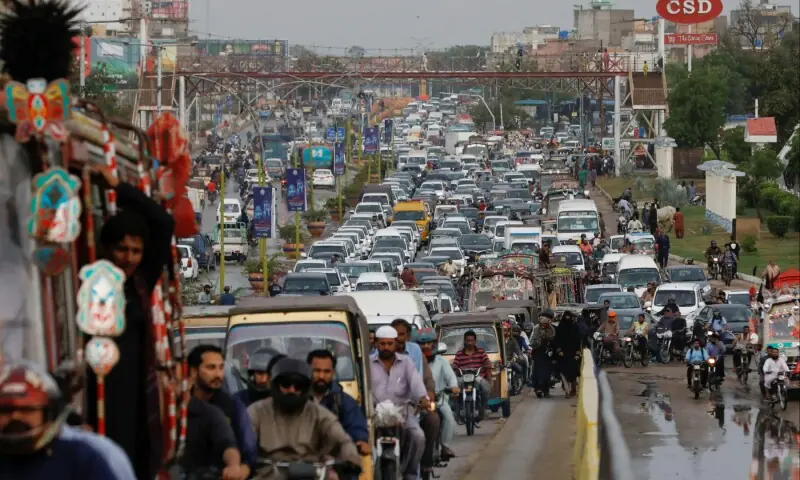
Header Image: A general view shows road traffic during the monsoon rain in Karachi, Pakistan, on July 5, 2022. — Reuters /Akhtar Soomro/File
Dawn – Home
none@none.com (Zubair Faisal Abbasi)
Read More