


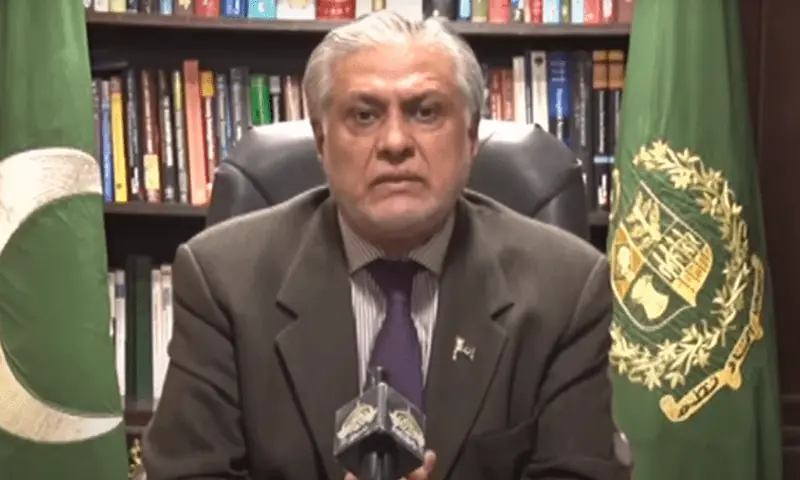
Deputy Prime Minister and Foreign Minister Ishaq Dar on Saturday hailed Pakistan’s success over India during the military escalation between the two countries earlier this year.
“A strong message was sent to the world,” he said while speaking to the media in Islamabad, where he gave an overview of Pakistan’s diplomatic efforts in 2025.
“Our international standing has […] improved due to principled, proactive and result-oriented diplomacy,” Dar said, reflecting on the past year. He said Pakistan was “known to be a diplomatically isolated country” at the time PM Shehbaz Sharif took oath last year.
Speaking on the May conflict, Dar said India’s claim of regional hegemony and being the net security provider was tested during the four-day escalation.
“We did not ask anyone to mediate between us,” the deputy premier asserted.
He recalled that Pakistan shot down seven jets of India during the May 7 air battle, which was followed by “incorrect” statements by New Delhi that Pakistan had attacked 15 Indian military installations. He also hailed the armed forces’ technology for intercepting 79 out of 80 drones sent by India to Pakistan in 36 hours.
The minister pointed out that Pakistan had remained “proactively engaged” after both the Pulwama and the Pahalgam incidents.
“This time, their mala fide intentions regarding the Indus waters. They have been corresponding with Pakistan for the last 1.5-2 years on climate change that ‘ground realities have changed’,” he said.
Detailing the May events, Dar said the civil-military leadership led by PM Shehbaz “authorised” certain decisions in a meeting on the night of May 9. He said India then “made the mistake” of attacking the Nur Khan Airbase in the early hours of May 10.
“The process which had been authorised by the PM had to be implemented,” Dar said, but India made the “super mistake”, which then led to Pakistan’s retaliatory operation.
“After April 22, we used to have long hours. From [May] 6 to 10, we used to be here at night too,” the minister said, adding that he conducted over 60 phone calls with foreign dignitaries before May 6 and after that.
Speaking about India’s claims of Islamabad attacking it, Dar said: “I told one of the P5 countries that this is a digital world, it cannot be hidden … they called me back after 16-17 hours and told me we had not attacked anywhere in India. This was a first serious setback for them.”
Detailing his exchanges with US Secretary of State Marco Rubio, Dar said, “At around 8:17am, I received a call from Secretary Rubio of USA that ‘India is ready to ceasefire, are you willing?’ I said ’we never wanted to go to war’.
“Within 45 minutes, I received a call from Saudi Foreign Minister Prince Faisal. ‘Brother, I understand that you have authorised Secretary Rubio. Am I permitted to talk to India’ […] Prince Faisal said I will talk to the foreign minister of India and get back,” Dar recalled.
He added that within an hour, the Saudi minister called him back and said he had also confirmed the ceasefire.
“It has been established that Pakistan’s armed forces, its technology and its capacity for defence is very solid. We only did in self-defence according to what was done to us; otherwise, it could have been much greater than this too,” the deputy PM said.
“Allah made [Pakistan] a nuclear power and a missile power. What you need now is economic power,” he stressed, highlighting that the country possessed great natural resources, such as mines and minerals, gas, and hydrocarbons.
“Related to Pahalgam and other incidents, our main analysis shared with everyone is that till the time the Jammu and Kashmir issue is not resolved, […] perpetual and permanent peace cannot be established in the region.”
The foreign minister reiterated Pakistan’s protest against India’s actions in occupied Kashmir, including “demographic changes and amendments in the Constitution”.
Dar noted that the May episode had revived the Kashmir issue at the international level, with the United Nations Security Council also discussing agendas related to human rights violations in India-occupied Kashmir.
On the Indus Waters Treaty, Dar said the FO had actively engaged with the UN High Commissioner for Human Rights, the Permanent Court of Arbitration, the Organisation of Islamic Cooperation (OIC) and others.
Ice breaks with Bangladesh
The deputy PM also highlighted that a “major ice-breaking breakthrough” occurred with Bangladesh as ties between the two nations revived.
Dar recalled that Hina Rabbani Khar had visited Bangladesh in 2012, but there had been no engagement afterwards because of the “anti-Pakistan” government there.
“My 36-hour visit to Bangladesh was very engaging. I had meetings with the chief executive, the foreign minister and cabinet ministers and advisers,” he observed.
“During my time there of 36 hours, I saw great gestures of goodwill for Pakistan,” Dar said, adding that Islamabad will proactively engage with Dhaka after the February polls.
“Pakistan’s diplomacy during the crisis demonstrated our proactive approach and it showed our ability of transforming challenges into opportunities and our thought of effective narrative projection with principled engagement,” the minister said.
Positive ties with US
Dar hailed the United States’ “proactive role” in the Pak-India ceasefire.
“That is why on June 11, we nominated [President Donald] Trump for the Nobel Peace Prize 2026. The media had confusion on the date. I signed the letter on the authorisation of PM and sent it,” he said.
“President Trump trumpeted the drum of May conflict success the most,” Dar quipped.
“Around 60 times, he reiterated that Pakistan shot down six fighter jets of India. Then he praised the prime minister and the field marshal. The relations with the US have started again towards a positive trajectory,” he said.
Dawn – Homenone@none.com (News Desk)Read More