


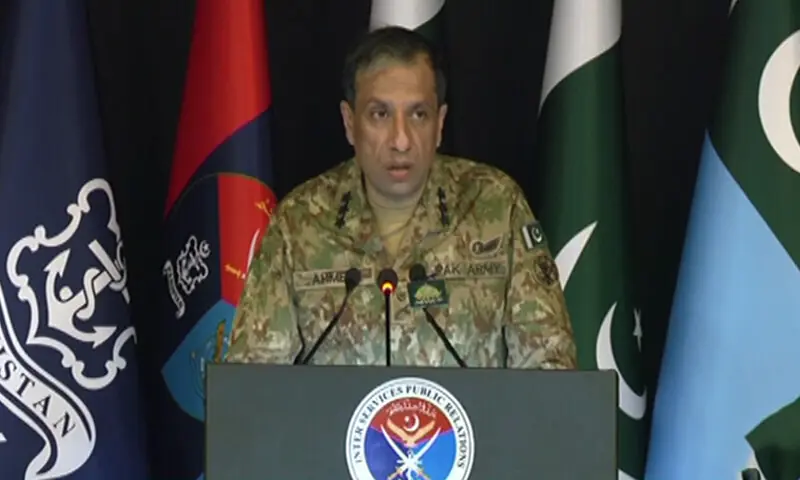
Inter-Services Public Relations (ISPR) Director General (DG) Lieutenant General Ahmed Sharif Chaudhry said on Tuesday that Afghans were involved in major “high-impact” terror incidents in Pakistan in 2025.
At the outset of the press conference, the military’s spokesperson said that the purpose of the briefing was to give a comprehensive overview of counter-terrorism measures taken in the past year.
This “is the only purpose of this press conference, and I would request that we remain focused on counter-terrorism as terrorism is the biggest threat that is being faced by the state of Pakistan,” he added.
The DG ISPR said 2025 was a “landmark and consequential year in our fight against terrorism”, adding there were four reasons behind this conclusion.
He maintained that the fight against terrorism concerned the entire nation and had been ongoing for more than two decades. The DG ISPR further stated that the past year witnessed “unprecedented intensity in counter-terrorism efforts.”
In 2025, he continued, the state of Pakistan, as well as the people, gained “complete clarity on terrorism”.
“The state already had this clarity, which permeated slowly and gradually down[ward] that these terrorists are khawarij [and] they have no relation with Islam. They are Fitna-al-Hindustan and have no relation with Pakistan or [the people of] Balochistan,” he elaborated.
Fitna-al-Khawarij is a term that the state has designated for the banned Tehreek-i-Taliban Pakistan (TTP), and it uses Fitna-al-Hindustan for Balochistan-based terrorist groups to highlight India’s alleged role in terrorism and destabilisation across Pakistan.
Lieutenant General Chaudhry further highlighted that in 2025, the world acknowledged Pakistan’s stance and narrative regarding terrorism, particularly Afghanistan becoming a “base for terrorist operations”.
Moreover, he added that the past year also demonstrated “how the National Action Plan (NAP) was reinvigorated and how it was being implemented”.
In this connection, he also mentioned that the vision for Azm-i-Istehkam — a counter-terrorism operation launched by the military in 2024 — was drawn from the revised NAP, and that all political parties and segments of society had reached a consensus on the necessity of implementing the NAP to eliminate terrorism.
He acknowledged, however, that “there are still deficiencies, and there is a lot of room for improvement” in the implementation of the NAP.
After outlining these four factors as the reasons behind declaring 2025 a “landmark and consequential year” in counter-terrorism, the DG ISPR went on to discuss them in detail.
75,175 IBOs in 2025
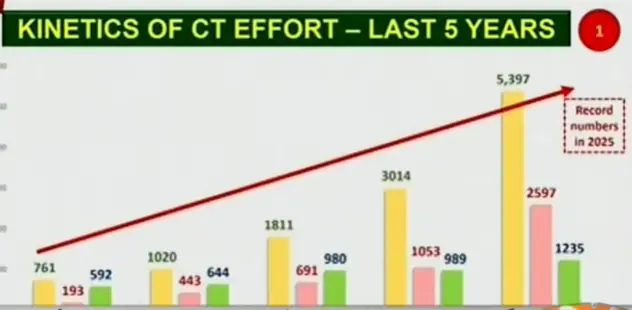
Sharing data, the military spokesperson said law enforcement agencies of Pakistan — including the army, police, Federal Constabulary, and intelligence agencies — conducted a total of 75,175 intelligence-based operations (IBOs) in 2025.
“Which comes down to 206 IBOs per day,” he said. Breaking it down, he noted that 14,658 operations were conducted in Khyber Pakhtunkhwa, 58,778 in Balochistan, and 1,739 in other regions of Pakistan.
He added that 5,397 terror incidents took place in Pakistan last year, of which 3,811 were reported from KP (71pc), 1,557 from Balochistan (29pc), and 29 from other areas.
Moreover, 2,597 terrorists were killed in Pakistan in 2025, the DG ISPR said. Among them, 1,800 were killed in KP, 784 in Balochistan, and 10 in other areas.
In 2025, he continued, 1,235 law enforcement personnel and civilians were martyred in the fight against terrorism.
Sharing data about suicide bombing incidents, he said a total of 27 had taken place in 2025. Of these, 16 occurred in KP, 10 in Balochistan, and one in Islamabad, at the judicial complex.
“Out of them, two [involved] female suicide bombers.”
In light of these facts and figures, he said, the question that came to mind was why the majority of terror incidents took place in KP.
“The primary reason for this is the politically conducive environment provided [to terrorists], and the political-terror nexus that is flourishing in the province,” he said.
The DG ISPR highlighted that data show terrorism began to rise in 2021. A total of 193 terrorists were killed that year compared to 592 law enforcement personnel who were martyred, a ratio of 1:3, he added.
Moving to 2025, he pointed out that 2,597 terrorists were killed last year, while 1,235 law enforcement personnel were martyred. This translated to a ratio of 2:1, he added.
“But more importantly, what happened in 2021 that caused terrorism to rise?” he questioned, and he elaborated on the reasons behind this development.
The DG ISPR explained that there was a change in Afghanistan in 2021 following the Doha Agreement.
“An armed group, the Afghan Taliban, sat down with the US and international partners and entered into an agreement. Under the agreement, they made three commitments — that they will form an inclusive government in Afghanistan, use of Afghan soil for terrorism will not be allowed and women will be given rights [in Afghanistan],” the DG ISPR recalled.
But were the commitments fulfilled, the military spokesperson questioned.
“They were not. Is there a government there? There is no government there. They [just] call themselves interim Afghan government […] Is there an inclusive government there? No, there is not.”
“Has terrorism been eradicated [from Afghanistan]? Contrarily, Afghanistan has become a hub of terrorists and non-state actors. Terrorists of different creeds operate from there. So that is what started happening in 2021.”
Naming various terror outfits that he said were operating from Afghanistan, the DG ISPR said Afghanistan had become a “centre point where terrorists of all kinds are being nurtured”.
He said that around 2,500 terrorists, who were neither Afghans nor Pakistanis, had recently reached Afghanistan from Syria.
The military spokesperson also said that the Afghan Taliban, “which is now the mother organisation,” had started organising the TTP according to its organisational structure. The DG ISPR added that they also trained and directed the terror outfit.
Moreover, the Afghan Taliban built a “fake” narrative, boasting that they forced the US and international coalition forces to flee Afghanistan.
“On the basis of that, they start further polluting the minds of youngsters, the youth and religious-minded people. They present themselves as the flag-bearers of Islam and increase their recruitment.”
“But if you analyse the matter, you will realise that they did not make them [coalition forces and the US] flee. There were other reasons for it.”
The DG ISPR also spoke about the war economy in this regard. He referred to a recent report by the Special Inspector General for Afghanistan Reconstruction, which he said mentioned that around $144 billion was pumped into the reconstruction of Afghanistan.
“When the [supply of] that money stopped, to continue running the war economy, they [Afghan Taliban] spread the war in the form of terrorism across the entire region. They find new patrons and financial sponsors, with the biggest patron for terrorism in Pakistan being India,” he said.
The DG ISPR added that India was using the Afghan Taliban as proxies and providing them with financial and other assistance.
“So the base of operations is being provided in Afghanistan by the Afghan Taliban and India’s money and patronage [is available].”
The military spokesperson added that the Afghan Taliban were taking the assistance of sponsors from elsewhere too — wherever they were able to find them — to run the war economy.
The military spokesperson elaborated that modern US equipment worth $7.2bn was left behind in Afghanistan. It included night-vision devices, high-powered sniper rifles, body armour and other personal protection equipment, M-4 and M-16 assault rifles — “the best of weapons and ammunition”.
This equipment was “available to the Afghan Taliban, in the black market, to all these terrorist organisations”.
Moreover, the political party in power in Pakistan in 2021 began “internally facilitating terrorists” and decided to hold talks with them while a “great game was being played in Afghanistan.”
This was seemingly a reference to talks held between the then-Pakistan government and the TTP.
The DG ISPR went on to say that “once you give them terrorists so much space and so much wherewithal, you see a rise in terror incidents.”
By 2023, he added, that state began standing against them.
Lieutenant General Chaudhry referred to a speech by the army chief following a blast in a mosque in Police Lines, Peshawar, in 2023, adding that on that occasion, the army chief gave clarity on terrorism. “Entire Pakistan has that clarity now.”
Further elaborating on this “clarity,” he used strong language, saying that terrorists had no religious association; they had to be eliminated, and action had to be taken against them.
“But it takes time. Because if you have to fight them, you have to equip yourself, train yourself, adopt the right technology, build the narrative, and take the nation along.
“You saw this last year, which I said was a consequential and landmark year, when the tide started turning.”
The military spokesperson acknowledged that questions were also raised about the large number of terror incidents: 5,397 in 2025.
“Yes, this is a big number. Why? Because we are engaging them everywhere. We are conducting 75,000 IBOs, 206 per day, and we are taking them on.“
“By ‘we,’ I mean myself, you, and everyone in Pakistan. We have absolute clarity that we have to win this fight, not by appeasement, but by force and strength. There are a few things in life worth fighting for, where fighting is not only justified but necessary, and there is no alternative.”
He said that when terrorism has reared its head in other countries, it has destroyed states. “But your state, your law enforcement agencies, and your army are fighting on a daily basis.”
Terrorism surge after May conflict
Referring to a chart, he said it could be deduced from the data that after Pakistan defeated India during a four-day conflict in May 2025, terrorism surged. After its defeat, “Indians immediately sought to influence non-state actors.”
Afghanistan served as the base of operations for those incidents, he said, adding that Pakistan repeatedly urged Kabul to end cross-border terrorism.
“And then we carried out strikes on terrorists along the Pak-Afghan border in October, not targeting the Afghan Taliban or their posts. And what did the Afghan Taliban regime do, which is acting as a proxy and a base of operations for Indians? They attacked Pakistani posts, coming in direct support of the terrorists.“
“So the state of Pakistan did what was necessary. Dozens of Afghan posts were obliterated within hours, and a hard message was sent.”
The DG ISPR said that posts were obliterated not just at the border but also inside Afghanistan.
He added that the border was closed after that, and terror incidents and the facilitation of terrorists declined.
“The number of terrorists killed in the last three months after the border was closed in October rose to 276 per month. There are signs here for those who can understand.”
He said parallels had been drawn between Pakistan‘s actions in October last year and India’s in May 2025.
“Those drawing the parallel are trying to spin a narrative,” he said.
He added, “In May 2025, India targeted Pakistani citizens; Pakistan, however, did not target Afghans in October.”
“We targeted our own citizens who were present there and involved in terrorism in Pakistan. They have training centres there.
“We knew TTP was present there. Did we target TTA (Tehreek-i-Taliban Afghanistan)? No, we did not.
“Only the state of Pakistan has the right to punish or reward its citizens in accordance with the law and Constitution of Pakistan. Who is India to cause harm to any Pakistani citizen?”
He again asserted that in the October strikes, Pakistan’s military targeted the TTP.
The DG ISPR said Pakistan had been pressing the Afghan Taliban for the constitution of a verifiable mechanism, adding that Pakistan had evidence of where and to whom the Afghan Taliban had been providing refuge.
Stressing the difference between India‘s and Pakistan’s cross-border strikes, he said whoever tried to point out similarities between the two developments was lying.
They were trying to deceive the people, spinning a misleading narrative, the DG ISPR said.
Listing 10 “major” incidents of terrorism in Pakistan in 2025, he said: “And who are involved in all of these high-impact [terror incidents]? They are all Afghans.”
The DG ISPR said all 78 terrorists involved in the 10 major incidents were killed. “None of them went back alive, and 60 civilians were martyred in those incidents. So the narrative they create that it is the military’s fight [is false]. This is the fight of the people. […] If we and you did not stand up against them, they would blow themselves up in your homes, markets, offices, schools, and streets until you adopt their perverted ideology.”
After playing “confessional statements by some terrorists,” he said that 16 of the terrorists killed in 2025 could be clearly identified as high-value targets. They included Amjad Ali, who was the second-in-command in the shura of the TTP.
He then asked his audience to rise from their seats, and those in uniform to salute, to pay tribute to the “martyrs,” including the people of Pakistan and personnel of the police, armed forces, and Federal Constabulary, who had lost their lives in terror incidents.
Three main pillars of counter-terrorism
Following that, the DG ISPR said there were three main pillars of the fight against terrorism.
Essentially, it was intelligence-based, he said, but there were three main pillars of its final manifestation on the ground.
The first among these pillars was the engagements on the Pak-Afghan border, the second was offensive actions by small teams, and the third was the technical surveillance and engagements, he explained. “These are the three pillars that are based on intelligence.”
Speaking about technical surveillance and engagement, he said a narrative was created that Pakistan’s military was using drones.
But in fact, it was the terrorists who began using those armed quadcopters, he said, adding that 405 quadcopter attacks by the terrorists were reported from KP alone during the year.
“Their patron — India — provides them with funds, technical inventory and other assistance. So they have now started going into this armed quadcopter business. They also have a special wing for quadcopters in their organisations.
“They also use mosques, public places and houses as human shields.”
He explained that law enforcement bodies, including police and armed forces, were using drones only for technical surveillance.
The military’s spokesperson mentioned that even the KP government had provided law enforcement bodies with quadcopters, as terrorists had been using them.
He added that law enforcement did not use quadcopters in any built-up or populated area and ensured that there was no collateral damage.
“It is important to brief you on this as a false narrative is being spun regarding this,” he remarked. “We use it with care, and your army does not cause any collateral damage. We hit only terrorists and their facilitators.”
He said the army was not only engaged in kinetic action when it came to countering terrorism. It was also taking measures pertaining to “communication, engagement and social manoeuvre“, he said.
“In our view, this is even more important than killing the terrorists,” he said as videos of the military’s engagement with the public played in the background. “And the narrative they create that there is a law and order situation, there is a gap between the public and the state — absolutely not.
“I say with great pride that Pakistan’s people and the state are together.”
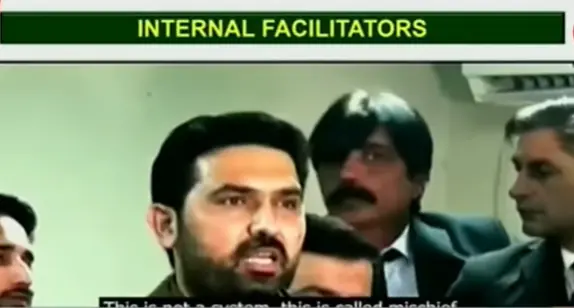
He said the people of Pakistan now had clarity on what Fitna-al-Khawarij and Fitna-al-Hindustan were, on the India-Afghan Taliban terrorism nexus, on the other external sponsors of terrorism, on the international acknowledgement and acceptance of Pakistan’s stance on terrorism and on internal facilitators — most of whom were found in politics — of terrorism.
India-Afghan Taliban nexus
Speaking about the India-Afghan Taliban nexus, he also played various clips of the Indian media as a portrayal of the “collusion”.
In this connection, he also mentioned those who “promoted terrorism under the guise of human rights and democracy.” He specifically cited a professor from the Balochistan University of Information Technology, Engineering and Management Sciences, who, the DG ISPR said, had confessed to involvement in terrorism.
The military spokesperson said the professor was defended by people in Pakistan and abroad and showed social media posts by various users, including freelance journalist Kiyya Baloch, the Baloch Yakjehti Committee, and human rights activist Imaan Zainab Mazari-Haazir.
He then said that the Afghan Taliban was not a government but a group that had occupied Afghanistan, under whose patronage more than a dozen terrorist organisations had been operating.
“Everyone knows this but the Khyber Pakhtunkhwa government,” he said, following which a video of KP Chief Minister Sohail Afridi was played.
In the video, Afridi was speaking in Pashto, and the DG ISPR quoted him as asking why other countries were not facing the issue of terrorism from Afghan soil.
He then pointed out that other countries, too, were facing the issue, adding that a false narrative was being spun.
The DG ISPR also rejected the impression that the fight against terrorism was being carried out in the pursuit of “dollars and minerals”.
A clip of PTI leader Asad Qaiser was also played, who rejected military operations in KP.
On this, the DG ISPR explained that the army was a federal force and worked under the instructions of the federal government. “We are constitutionally bound to ensure Pakistan’s territorial integrity and security.
“No one can allow you to hand over your areas to terrorists for your politics and to facilitate whosoever.”
Giving the example of ANP being targeted by terrorists after the party voiced opposition to terrorism, the DG ISPR, without naming the PTI, said: “They are saying that they are not ready to die. That they will not stand up. That they will join them (terrorists).“
Again without naming the PTI, he raised the question of why terrorists had not ever targeted the party.
Then, showing a news report about “KP seeking Afghan help for negotiations”, the DG ISPR remarked: “What policy of appeasement is this in which you are begging Kabul?”
“Their narrative also came out in the open in 2025.”
Then, coming back to the revised NAP, he said the kinetic action detailed under it was already being taken by security forces.
The rest of the provisions under the plan had to be fulfilled by society, political parties and provincial, federal and district governments, not the army.
“On this, what we feel is that there is a reinvigoration under the vision of Azm-i-Istehkam.”
He said a case study regarding this was about how the plan was being implemented in Balochistan. And “we should be very proud” of it, he added.
“The credit must go to the chief minister and the government of Balochistan. What they have done is — and they will soon provide you with a comprehensive and final document — they have constituted district-level coordination committees, which include local MPAs, DC, DPO, and representatives of the army and intelligence [agencies].
“So the devolution sense in a real sense is reaching the districts of Balochistan through these district coordination committees.”
The DG ISPR shared that 472 meetings had been held of these committees between February and November 2025, since their constitution.
“Funds of Rs23bn by the Balochistan government and Rs8bn by the federal government have been made available to each committee at the district level,” he said, adding that locals were included in the committees and identified projects that needed to be executed.
He said 127 projects have been completed, and 949 had been planned under this plan. Moreover, 54,000 social activities and engagements had been carried out under this plan, in which government and law enforcement functionaries, army representatives and political functionaries engage with the people.
He said the Balochistan government was expeditiously working on this “NAP Balochistan”, further stating that the distinction between category-A and category-B areas in Balochistan had ended.
“By law, the government of Balochistan has converted everything into Cat-A, which means that now there is a Balochistan police mandate all across Balochistan.
“This will have far-reaching consequences. This is again part of efforts to combat terrorism at the ground level and terror-crime nexus at the grassroots level.”
He said the Balochistan’s government had allocated Rs5bn separately for training the police and the Counter-Terrorism Department as part of this.
The DG ISPR said the authorities had managed to curb the smuggling of Iranian oil in Balochistan in a bid to combat the political-terror-criminal nexus.
He also highlighted that the high number of pending terrorism cases in courts in KP and the low conviction rate as other reasons behind the failure to eradicate terrorism from the province.
Moreover, the military’s spokesperson said two more areas that were being addressed under the revised NAP were narcotics — as it was connected to terrorism — and illegal weapons.
In both areas, he said the conviction rate was low.
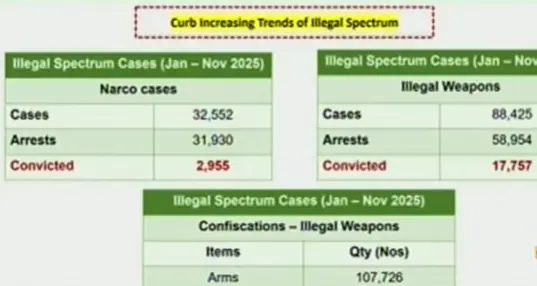
“It is not the job of the army, but it has a direct bearing on our counter-terrorism efforts.”
Afghan repatriation
Gen Chaudhry said another important facet of the revised NAP was the repatriation of Afghans. He said Punjab had just one Afghan refugee camp that had been cleared and similarly, all 10 refugee camps in Balochistan had also been cleared.
In contrast, of the 43 refugee camps in KP, just five had been cleared, he said.
The DG ISPR said that of around 150,000 refugees repatriated from KP, 1.2 per cent had been “deported”.
Deportation “means that an individual had been checked and found to be illegally [staying]. [Deportation] provides the impetus for others to leave willingly”.
“In other provinces, the percentage of deportation is much higher. That means law enforcement agencies are not being given a freehand there (KP). […] The people and law enforcement bodies in KP want [repatriation of Afghans], but why are they not being utilised for this?” he said.
The DG ISPR said a Pakistan Land Port Authority had been established, which would contribute to NAP’s reinvigoration. The body would facilitate coordination among agencies operating at land ports, he explained.
He said the National Intelligence Fusion and Threat Assessment Centre had also been established and termed it a “fusion of multiple agencies in one place”.
He said a major terrorist attack had been averted in Karachi recently, for which the “fusion of intelligence” happened at NIFTAC and provincial centres associated with the body.
He ended his briefing, asserting that the fight against terrorism would continue “with the singularity of purpose and singularity of narrative”.
“Those in uniform and those not in uniform have to fight together and win this fight. And no power in the world can stop us from winning this fight.”
‘Afghan border closure more beneficial than a loss’
When a journalist asked whether Pakistan was ready for a full-fledged war after availing multiple other options in recent months but “getting nothing out of it,” the DG ISPR disputed the phrasing. He noted that the ratio of terrorists killed to people martyred was now 2:1, up from 1:3 in 2021, and that Pakistan’s stance was being acknowledged globally.
“Pakistan was the first to say, two years ago, that attention needed to be paid to Afghanistan, where terrorists from across the world have gathered. Now, a United Nations report states that there are 20 regional terrorist organisations there.”
Gen Chaudhry further said, “We will trace them and their facilitators. No one should have any doubt about Pakistan’s resolve—its public, its armed forces, and its political and military leadership.”
Asked about the future of the Pak-Afghan border, the DG ISPR noted that the state’s top-most priority was the security and territorial integrity of Pakistan.
He stressed that the border had been closed for a reason, which had also been communicated to Kabul. About Pakistani students in Afghanistan, the DG ISPR said the state will do whatever is necessary for their protection.
At another point, when asked about Afghanistan’s demand for a separate trade pact to reopen the border, the DG ISPR stated that the border closure only had “advantages” for Pakistan and no losses, as terrorism was permeating through it.
Asked what the “long-term solution” for Afghanistan was, the DG ISPR said, “We will play all the cards, and we will engage with them where we have to in a hard manner. Where we have to engage them diplomatically, we will do that as well.”
Asked if there was any hope of a change in Afghanistan’s attitude due to the recent joint statement by Pakistan and China, the DG ISPR said Islamabad and Beijing “see in the same way on regional terrorism“, and therefore cooperation in that domain is maintained. He said there was consensus in the entire region that Afghanistan had become the centre of terrorism.
On whether a regime-change operation in Afghanistan, similar to the recent operation in Venezuela, would be in Pakistan’s favour, the DG ISPR said it was for Afghans to decide. “We have to take care of our country. That is enough for us.”
On Pakistan’s future stance on such a development, Gen Chaudhry said the state would “curate its policy based on the circumstances at that time” and stressed that the foreign ministry takes the lead in such matters.
Asked about who was supporting the IS-KP terrorists in Pakistan, as the group and the Afghan Taliban were enemies, the DG ISPR questioned who termed them as each other’s enemies.
The DG ISPR asserted that terrorists have no ideology, whether it is the Daesh, Al Qaeda, TTP, FAK, FAH, or ETIM. “They have no nationality, humanity or ethnicity,” Gen Chaudhry said. “They all have one father — the Afghan Taliban. About them killing each other, you have been covering for a long time that one faction kills another.”
“As far as Pakistan is concerned, there is no shade or colour of any sort of terrorist. We have no space or sympathy for any terrorist. I have already said that there is only one type of good terrorist: a dead terrorist,” the DG ISPR stated.
He stressed that the nation has to fight the war of narratives, technology, and intelligence. He quipped that terrorists were “baffled” by Pakistan continuing to move forward despite various militant groups thrown in the mix, along with sectarian strife and internal political facilitators.
Asked if Pakistan would inevitably carry out more strikes against the TTP in Afghanistan, the DG ISPR highlighted that in October 2025, Pakistan only carried out strikes “at the Pak-Afghan border area, on the terrorists that were infiltrating into Pakistan and those who were planning to go across into Pakistan and the places they were being organised”.
He stressed that it was the TTP, who were Pakistani citizens, who were struck. Gen Chaudhry noted that it was the Afghan Taliban who struck the Pakistani posts then, which gave Pakistan the “full right to respond” as its territorial integrity was attacked.
Questioned whether Pakistan had given the Afghan Taliban legitimacy by holding talks with them in Doha and Istanbul last year, the DG ISPR answered that they are the de facto rulers in Afghanistan. He pointed out that talks have been held during the entire period from 2021 to 2025, so there was “nothing new” about that now.
“Who else will you speak with?” Gen Chaudhry said, adding that since 2021, high-level delegation visits have taken place, 225 border flag meetings have occurred, 836 protest letters have been written, and 13 demarches have been issued to the same Afghan Taliban.
Issues in KP
Asked whether there was any hope of the federal government taking action to remove the hindrances in KP, such as by imposing governor’s rule, the DG ISPR said these decisions were up to the political leadership to decide. “This is for them to decide. They have to see multiple things. A soldier thinks in black and white [but] a politician thinks in multiple shades.”
“Our job is to separate the truth and the lies. We call a spade a spade,” Gen Chaudhry said, adding that the current counter-terrorism narrative of declaring terrorists Khariji began in 2023.
On whether the military was willing to hold talks with KP Chief Minister Sohail Afridi, the DG ISPR said dialogue was for the government to have.
Asked at another point what the solution to the lack of political will in KP was, the DG ISPR said politicians had to resolve those issues. “We are a democratic country. There is a parliamentary democratic system, which has the solution to this.”
The military spokesman asserted, “Our job is to give the state and the public our perspective based on facts and cold logic. We have no emotions in this.”
The military spokesperson termed the field marshal the “source of the clarity” of not holding any talks with the terrorists or giving them any space, and instead fighting them as per God’s directives. “The truth will come out if someone has personal vested interests and does not want to obtain that clarity.”
On the KP government‘s decision to abolish the Action in Aid of Civil Power Ordinance and the army‘s plan of action for military operations, the DG ISPR said under Article 245, the armed forces were to defend Pakistan as per the federal government’s directives.
“The validity of any direction issued by the federal government under Clause 1 shall not be called in question in any court,” he quoted Article 245 as saying.
On how the military would launch any operation or conduct IBOs in KP when there was a difference of opinion with its provincial leadership, the military spokesperson pointed out that “operations” were continuing despite the KP CM saying they would not allow kinetic actions.
“Those who say we will not allow [operations], are their personalities or statements above Pakistan’s sovereignty?” he asked rhetorically.
“This is a war of our sovereignty. This is Pakistan’s war. No personality or politics is above Pakistan,” he asserted.
‘Cannot blame institution for certain persons’ acts’
Responding to a query about the military leadership’s involvement in the 2021 “rehabilitation” policy and their accountability, and whether calling out only the political leadership would be “selective justice”, the DG ISPR rebutted that the military leadership had input in the decision.
“We have a political narrative imposed on us wherein powers are taken in full but not the responsibility. The method to it is saying ‘we were powerless’. The government has the authority,” Gen Chaudhry said, adding that both the current government and its predecessor had authority.
The military spokesman further said that some institutions were “not as empowered as they should be because of the politicisation that has crept into them over time”. “We repeatedly say not to impose any politics on us […] All political parties, political leaders and political ideologies, ethnicities, communities, religions, sects are equal for us as long as they are Pakistani.”
The DG ISPR, without taking names, alluded to Imran Khan and said he was “running his party like a dictator” and added that he was insistent on holding talks with the Afghan regime.
He quipped that he [Imran] was so empowered that he had even declared the then-army chief Gen Qamar Javed Bajwa as “father of the nation”, a title that is reserved for Quaid-i-Azam Muhammad Ali Jinnah.
Gen Chaudhry added that then-intelligence chief — referring to Faiz Hameed — was “used for politics”. “You cannot put this [blame] on the institution; it was a field of characters.”
Dawn – Homenone@none.com (News Desk)Read More