

ISLAMABAD: Despite the government’s proclamations of reforms and economic stabilisation, the overall financial performance of state-owned entities (SOEs) deteriorated further in 2024-25, with their consolidated losses surging by 302 per cent, mainly led by the power sector, according to the Ministry of Finance (MoF).
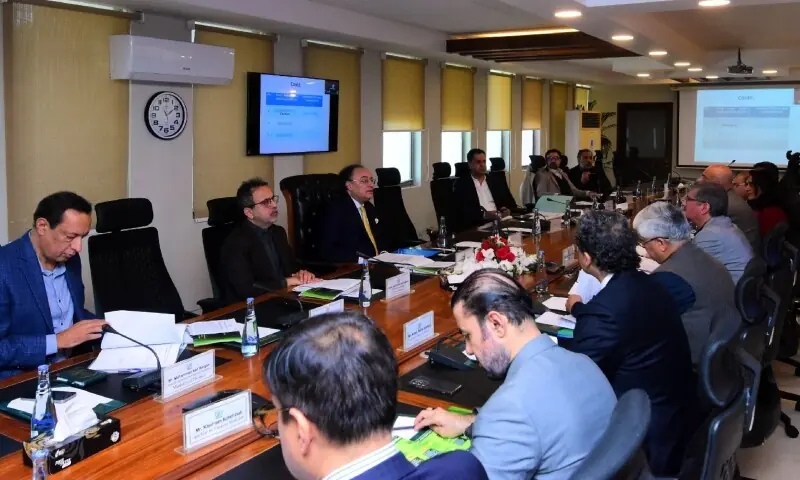
The ministry confirmed that not only did overall revenues decline, but consolidated profits also fell, and financial losses and budget injections increased in 2024-25 compared to the previous year. The consolidated financial results of the SOEs firmed up by Central Monitoring Unit (CMU) of the MoF came up for review before a meeting of the Cabinet Committee on SOE (CCoSOEs) presided over by Finance Minister Muhammad Aurangzeb on Friday.
The committee was informed that “during 2024-25, aggregate revenues of SOEs stood at approximately Rs12.4 trillion, reflecting a decline largely attributable to reduced profitability in the oil sector following lower international oil prices,” the MoF said.
Aggregate profits of profit-making SOEs declined by 13pc to Rs709.9bn compared to Rs820.7bn last year, while aggregate losses of loss-making SOEs showed improvement, declining by around 2pc to Rs832.8bn. “Despite this improvement, the net result was an overall net loss of Rs122.9bn for the SOE sector, compared to a net loss of Rs30.6bn in the previous year,” showing more than three times increase, the MoF said.
Finance ministry cites power sector drag in FY25 performance
It was highlighted that losses remain heavily concentrated in a small number of entities, particularly in the transport and power distribution sectors. National Highway Authority and several power distribution companies continued to be major loss contributors, reflecting structural issues, high depreciation, financing costs, and the public service nature of certain operations that are not commercially viable.
The committee was briefed on the categorization of SOEs into green, amber and red categories based on financial sustainability, with a view to prioritising reforms and decision-making.
On fiscal support, the committee noted that total government support to SOEs increased to Rs2.078tr during 2024-25, driven mainly by higher equity injections to clear circular debt stock, while subsidies showed a modest decline. At the same time, inflows from SOEs to the government increased to Rs2.119tr, supported by higher dividends, tax receipts and interest income on government lending.
The debt profile of SOEs was discussed in detail. Total SOE debt at the portfolio level increased to Rs9.57tr, comprising cash development loans, foreign re-lent loans, bank borrowings and accrued interest. The committee was also explained the quantification of unfunded pension liabilities across SOEs, estimated at around Rs2tr, which was identified as a major legacy risk requiring policy attention. Guarantees and other off-balance-sheet contingencies were reported at Rs2.16tr.
The meeting reaffirmed commitment to transparency and structural reforms while reviewing the Annual Consolidated Performance Report of Commercial and Non-Commercial State-Owned Enterprises (SOEs) for 2024-25. Director General CMU Majid Soofi presented the report and briefed the committee.
The report covered the financial and non-financial performance of SOEs, government support and fiscal flows, contribution of SOEs to the exchequer, debt profile, corporate governance and compliance status, business plan assessments, and the proposed way forward under the SOEs Act 2023.
The finance minister commended the CMU for strengthening transparency, consolidating SOE financial information on an International Financial Reporting Standards (IFRS) aligned basis, and establishing a comprehensive digital database to support evidence-based decision-making.
He noted that the presentation reflected meaningful progress in oversight, disclosure and risk identification, particularly in areas of fiscal flows, debt mapping and unfunded pension liabilities.
The minister said the report was a credible foundation for informed policy action and sustained reforms, and reaffirmed the government’s commitment to improving governance, enforcing accountability, and placing SOEs on a path toward financial sustainability and operational efficiency.
The meeting stressed the need for enforcement of audit completion in compliance with the SOEs Act 2023, and timely transition to IFRS-based reporting by February 2026. The importance of realistic business plans, sector-specific engagement, loss reduction strategies and hard budget constraints, particularly for chronically loss-making entities, was also underscored.
Published in Dawn, January 10th, 2026
Dawn – Homenone@none.com (Khaleeq Kiani)Read More