

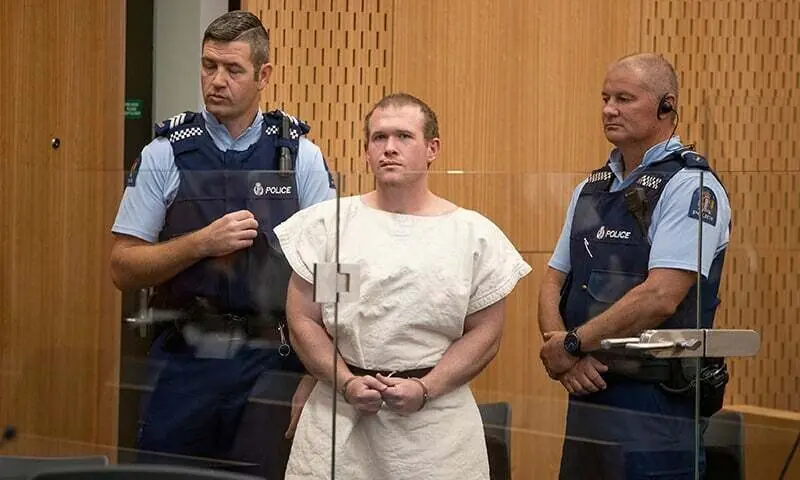
White supremacist killer Brenton Tarrant lost on Thursday an appeal seeking to overturn his conviction and sentence for shooting dead 51 people at two New Zealand mosques in 2019, court documents showed.
The 35-year-old admitted to carrying out New Zealand’s deadliest modern day mass shooting before being sentenced to life in prison in August 2020.
He appealed to the Court of Appeal in February, saying “torturous and inhumane” detention conditions during his trial made him incapable of making rational decisions when he pleaded guilty.
“I did not have the mind frame or mental health required to be making informed decisions at that time,” Tarrant said at the time.
The panel of three judges said the court “does not accept Mr Tarrant’s evidence about his mental state.”
“There were inconsistencies in Mr Tarrant’s own evidence, and his evidence is at odds with the detailed observations of prison authorities and the assessments of mental health professionals at the time of him entering his pleas.”
The judges found Tarrant’s guilty pleas were voluntary and “he was not coerced or pressured in any way to plead guilty”.
“The evidence overwhelmingly demonstrates that he was not suffering any significant psychological impacts as a result of his prison conditions at the time he pleaded guilty,” the court said.
The court said Tarrant’s “proposed conviction appeal is utterly devoid of merit”.
“The facts concerning Mr Tarrant’s offending are beyond dispute. He has not identified any arguable defence, or indeed any defence known to the law.”
‘Huge relief’
Tarrant’s penalty of life imprisonment without parole was the stiffest in New Zealand history.
Armed with an arsenal of semi-automatic weapons, Tarrant attacked worshippers at two mosques in Christchurch on March 15, 2019.
He published an online manifesto before the attacks and then livestreamed the killings for 17 minutes.
His victims were all Muslim and included children, women and the elderly.
The court’s decision was complicated one week after Tarrant’s February hearing when he sought to abandon his appeal entirely.
The judges said the court received a notice of abandonment of appeal signed by Tarrant using a “self-styled moniker” but the document was thrown out because it was not dated or witnessed.
Tarrant filed a second notice later that week, again using a pseudonym, which was dated and witnessed.
He said he “no longer wishes to have a lawyer” and the appeal should not continue as “it would likely lead to a miscarriage of justice”.
Lawyers acting for the survivors and families of victims told national broadcaster RNZ the decision had been a “huge relief”.
“The law has now done its job,” they said.
“The families, and frankly all of us, will be spared the trauma of reliving the 15th of March all over again in a trial.
“It is a huge relief that the difficult and often unsupported journey families are on will not now be added to by the great burden of a new trial. It would have been unimaginably traumatic. “
Dawn – Homenone@none.com (AFP)Read More