

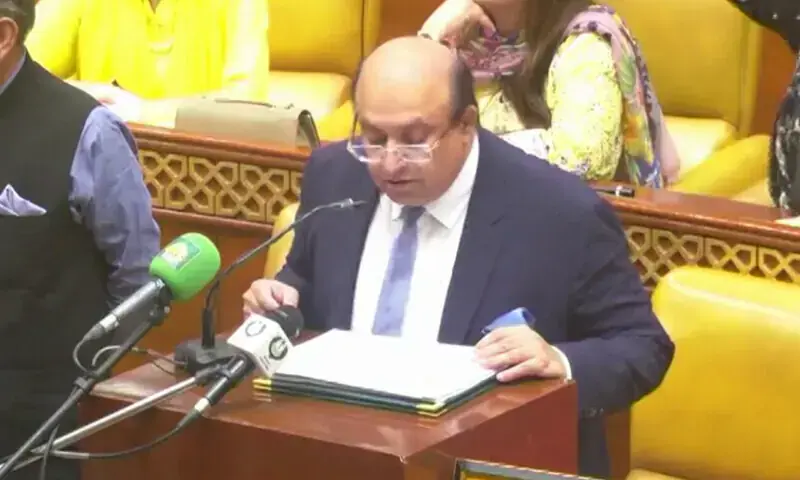
LAHORE: Punjab will establish a unified revenue authority on the model of the Federal Board of Revenue (FBR) during the next fiscal year, bringing all provincial taxes under a single institutional framework, Finance Minister Mian Mujtaba Shujaur Rehman told a post-budget press conference here on Wednesday.
The province successfully achieved 99 per cent of its tax collection target during the outgoing fiscal year, while the revenue target for FY 2026-27 has been increased by 46pc, he added.
Expressing confidence in the government’s revenue reforms, he said the enhanced target would also be achieved successfully.
Accompanied by Senior Minister Marriyum Aurangzeb, Information Minister Azma Bukhari and others, Rehman announced that Punjab’s own-source revenues are expected to witness an increase of 30 to 40pc.
Says streams of revenue to come under single institutional framework; rebuffs certain rumours relating to revenue and development
He claimed that significant improvements in revenue collection have been achieved through eliminating corruption in the tax administration and expanding the provincial tax base.
He stated that during the current fiscal year, the Punjab Revenue Authority (PRA) exceeded its assigned target by collecting 30pc more revenue, while the Excise and Taxation Department recorded a 12pc increase in collections. Among the non-tax revenue-generating departments, the Mines and Minerals Department emerged as the leading contributor.
In view of the sustained growth in revenue generation, the collection target for the Punjab Revenue Authority has been enhanced to Rs528 billion for the next fiscal year, while the Excise and Taxation Department has been assigned a target of Rs124bn. Similarly, a target of Rs461bn has been proposed for non-tax departments.
The minister said only a modest revision in certain existing tax rates has been proposed for the upcoming fiscal year in light of prevailing economic circumstances.
He explained that one of the key reasons behind this adjustment was Punjab’s decision to provide a grant of Rs546bn to the Federation, which effectively reduced the province’s development budget from Rs 1,240bn to Rs752bn.
He clarified that despite the reduction in development resources, no compromise was made on the province’s development agenda or the provision of public services. The resulting fiscal gap is being addressed through rationalisation of current expenditures and by promoting greater economic activity across the province.
Responding to media queries, the minister observed that the taxes whose rates have been revised for the upcoming fiscal year had remained unchanged for several decades. He pointed out that the proposed amendments to the agricultural tax, which has remained unchanged since 1998, will apply only to landholdings exceeding 12.5 acres.
He announced that following the successful digitisation of revenue collection under the Excise and Taxation Department, the Board of Revenue’s collection system will also be shifted online. The property tax regime is being fully digitised to eliminate corruption and improve efficiency. Simultaneously, with
the expansion of the Punjab Revenue Authority’s mandate, its human resource capacity is also being strengthened.
Aurangzeb said that scheduled for completion this July, a unified socio-economic registry will streamline the issuance of multiple welfare cards, including the Himmat and Kisan cards, driving data-based decision-making for all social protection projects.
She strongly denied assertions that agriculture or southern Punjab were being ignored, terming such narratives factually incorrect. Statistics show that both acreage and crop output have surged, pushing overall agricultural growth up.
“Out of 5,500 acres dedicated to the new aquaculture initiative, 5,000 acres are situated exclusively in south Punjab,” she stated, rejecting political point-scoring. Refuting rumours of an exorbitant Rs145bn traffic fine target, the government clarified that the actual target is capped at Rs45bn.
Refuting claims regarding unapproved projects, officials confirmed that PC-1 documents for 493 new schemes, including the upcoming laptop scheme, will be finalised by June 30.
Dismissing reports that Punjab’s ADP utilisation was frozen at Rs752bn due to a lower actual spending, officials clarified that the actual allocation discussed at the National Economic Council was Rs1,030bn, which had to be rationalised solely due to FBR revenue shortfalls.
Published in Dawn, June 18th, 2026
Dawn – Homenone@none.com (The Newspaper’s Staff Reporter)Read More