

• US expected to press China on de-escalation efforts with Tehran
• Taiwan, tariffs and rare earths to dominate talks
• China ‘changes Rubio’s name’
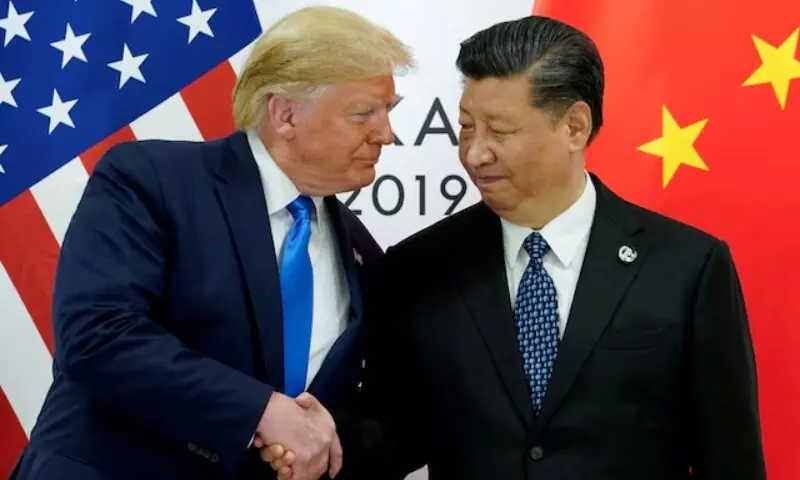
BEIJING: US President Donald Trump has said he expects a “big, fat hug” from his Chinese counterpart Xi Jinping when they meet in Beijing this week, though multiple thorny issues between the two sides could see the former kept at arm’s length.
Taiwan, tariffs, rare earths and the US-Israel war on Iran are among the contentious topics set to be discussed by the two leaders, whose styles of communication could hardly be more different.
Trump’s often bombastic, freewheeling comportment on the international stage contrasts dramatically with Xi’s measured, tight-lipped approach to foreign policy.
In mid-April, the US president predicted that Xi would greet him with a “big, fat hug” upon his arrival in Beijing, adding that “we are working together smartly, and very well!” China, in contrast, did not confirm the visit was taking place until Monday, typical of its reserve on such matters.
Despite the clash of styles, Beijing’s foreign ministry said on Monday that China considers leader-to-leader diplomacy as playing an “irreplaceable strategic guiding role in China-US relations”.
Trump’s trip to China is the first by a US president since he visited back in 2017. During that first-term sojourn, he received what the Chinese termed “state visit-plus” treatment, including a private tea reception in the Forbidden City.
Trump, who will turn 80 next month, and Xi, who will turn 73 a day later, last met face-to-face in October on the sidelines of a regional summit in South Korea. There, the two agreed to a one-year truce in a trade war that saw tariffs on many goods exceed 100 per cent.
His 2026 trip is expected to include a tour of the Temple of Heaven and a state banquet, but analysts say the pomp will not match that of nine years ago.
Since Trump’s first visit, China has learned that while “aggrandisement… plays to his ego, it cannot prevent him from a quick flip-flop in his attitude towards China”, Wu Xinbo, director of the Center for American Studies at Shanghai’s Fudan University, told AFP.
Washington is expected to press Beijing to use its considerable influence with Tehran to help de-escalate tensions and ensure freedom of navigation through the Strait of Hormuz, a vital artery for Chinese energy imports and global oil supplies.
US officials also hope China will avoid obstructing efforts at the United Nations to condemn attacks on commercial shipping in the Gulf.
China, meanwhile, has quietly positioned itself as a potential mediator. Together with Pakistan, Beijing has backed diplomatic initiatives aimed at securing a ceasefire and reopening maritime routes through Hormuz. Chinese and Pakistani officials reportedly advanced a five-point framework earlier this year designed to restart negotiations and contain the regional conflict.
US media reports and diplomatic observers believe both Washington and Beijing have encouraged Pakistan to play a mediating role because of Islamabad’s close ties with Tehran, Beijing and Gulf capitals alike.
Rubio’s ‘name change’
Meanwhile, Secretary of State Marco Rubio was heading to Beijing with President Donald Trump, despite being under Chinese sanctions — a breakthrough apparently made possible after China changed his name’s transliteration.
As a US senator, Rubio fiercely championed human rights in China, which retaliated by imposing sanctions on him twice — adopting a tactic more often used by the US against adversaries.
At his confirmation hearing as secretary of state, Rubio focused heavily on China, which he described as an unprecedented adversary.
Last year, however, Rubio said the Trump administration would not negotiate over the self-governing Taiwan’s future to secure a trade deal with China.
China seems to have found a diplomatic workaround after Trump named Rubio his secretary of state.
Shortly before he took office in January 2025, the Chinese government and official media began using a different Chinese character for “lu” to represent the first syllable in his surname.
Two diplomats said they believed China made the change because Rubio was under sanctions, which included an entry ban, under the old spelling of his name.
Published in Dawn, May 13th, 2026
Dawn – Homenone@none.com (AFP)Read More